
This post may contain affiliate links. Please read my disclosure policy.
All recipes on Doggone Baking are intended for humans — the dogs are just our enthusiastic photo assistants and taste-test spectators.
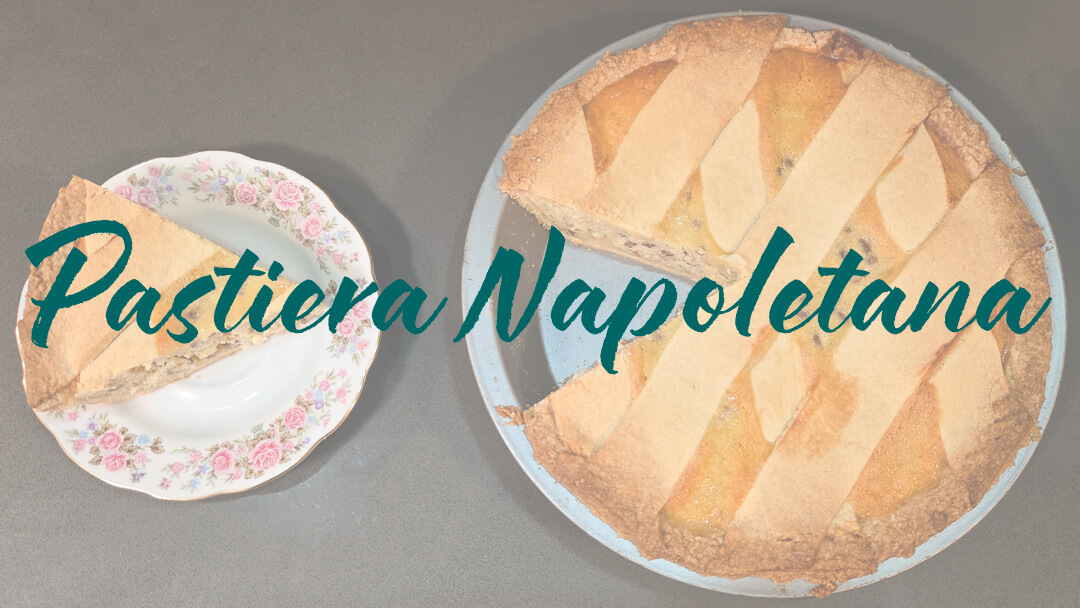
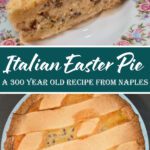
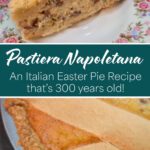
Pastiera Napoletana (Italian Easter Pie)
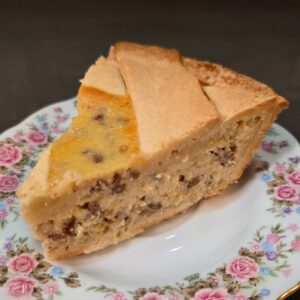
Pastiera Napoletana is a pie from Italy most frequently eaten around Easter, earning it the nickname Italian Easter Pie. It’s a labor of love, taking multiple days to complete from start to finish. Some of the Italian websites I looked at to research this pie even went so far as to say that after completing the multi-day endeavor of baking this pie, it then has to sit for three days before eating to allow the flavors to properly develop. All in all, some sites claim a proper Pastiera Napoletana takes a full week to make. However, if you do go through the whole process, this pie is delicious, light, creamy, and wholly different from most pies you’ve probably eaten.

What is Pastiera Napoletana
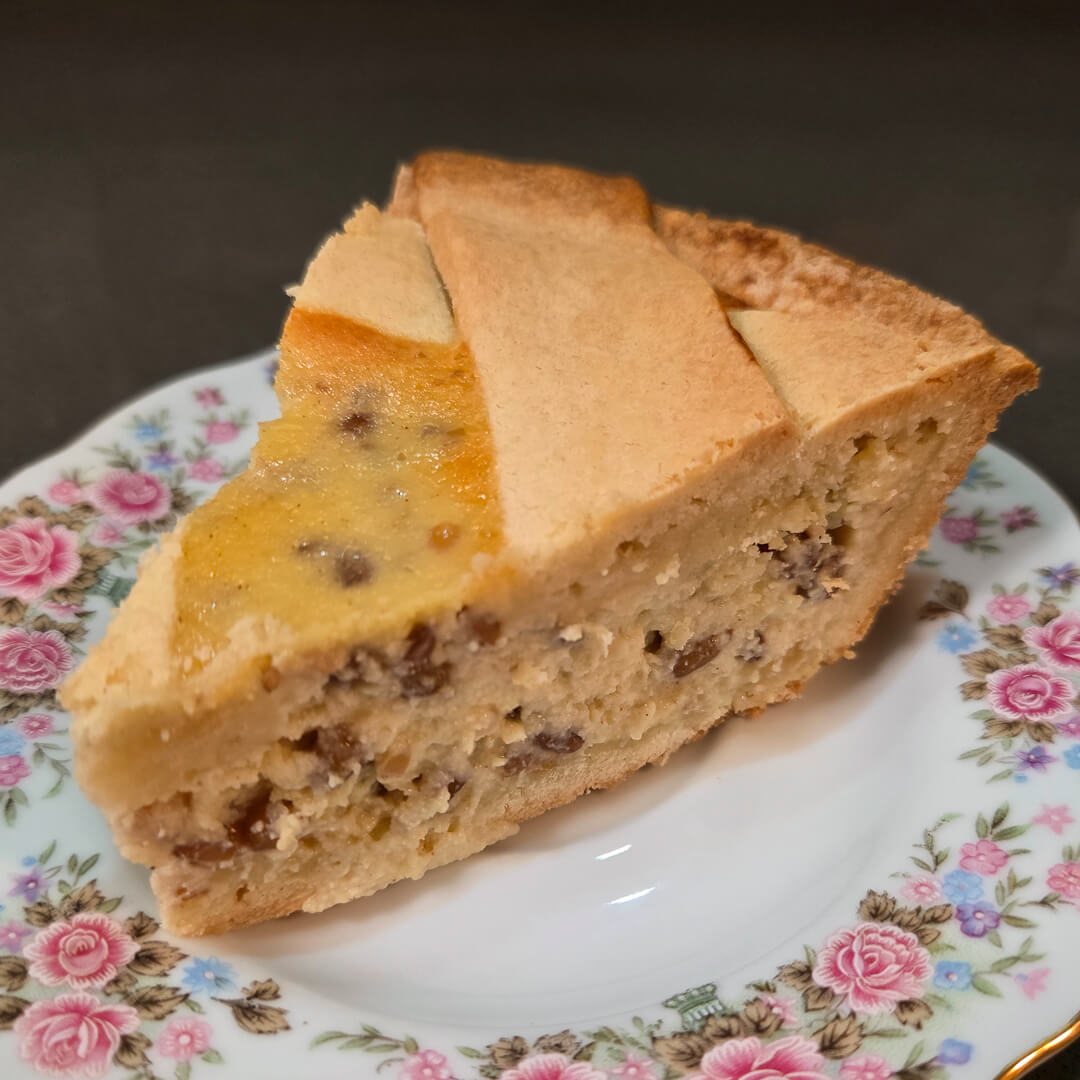
Pastiera Napoletana is so popular around Easter that it is sometimes also called Italian Easter Pie. Although there are other pastieras, such as pastiera di riso, Pastiera Napoletana has become so popular that if you search “pastiera” in Italy or the US, you’ll be bombarded by mostly Pastiera Napoletana recipes. The crust is an Italian shortcrust pastry called pasta frolla.
The filling is ricotta-based, studded with wheat berries boiled with milk and citrus peels, candied citrus, and flavored with orange blossom water. The result is a creamy, floral, and citrusy filling inside a sweet and crumbly crust. Traditional recipes call for letting your pastiera sit untouched for three days to fully allow the flavors to meld, the wheat to soften, and the pastry to soften to the perfect texture.
History of Pastiera Napoletana
While Pastiera Napoletana most likely originated in Naples, Italy in the 1500s, there is also a famous legend surrounding the dessert with roots in Ancient Greece.
The legend says that the siren Parthenope chose the Gulf of Naples as her home. From there, her melodious and sweet voice could be heard across the land. To celebrate her, the people of Naples brought her seven gifts: flour, ricotta, eggs, wheat cooked in milk, orange blossoms, spices, and sugar. Each gift carried symbolic meaning: flour represented wealth; ricotta represented abundance; eggs represented fertility; wheat symbolized the fusion of the animal and vegetable kingdoms; orange blossoms represented the scent of the Campania region; spices were a tribute from the people; and sugar celebrated the sweetness of the siren’s song. Parthenope accepted these gifts and created Pastiera Napoletana.
There are also theories that the dessert was an offering to Ceres, the goddess of agriculture and fertility, during spring celebrations. Another theory connects it to the milk and honey offered to catechumens during baptism on Easter night. Pastiera Napoletana most likely had pagan origins given the legends tying it to ancient Greek mythology, but over time it became woven into the Christian celebration of Easter.
Historians generally agree, however, that these are legends, and that the dessert did not actually come about until long after Ancient Greek civilization. Its origin is most often credited to the Monastery of San Gregorio Armeno in Naples sometime in the 16th century. The story goes that a nun from the convent set out to create a dessert that brought together ingredients rich in Christian symbolism, Asian spices, and the scent of orange blossoms from the Gulf of Naples. The pastiera was apparently so delicious that it even made Queen Maria Theresa of Austria, nicknamed “the Queen who never laughs,” smile.
The first printed recipe for Pastiera Napoletana appears in Lo Scalco alla Moderna by Antonio Latini, published in 1692. That original recipe included pistachios and parmesan, neither of which appear in most modern recipes. A recipe that more closely follows the modern style of pastiera was published in 1837 in the first edition of Cucina Teorico-Pratica by Ippolito Cavalcanti.
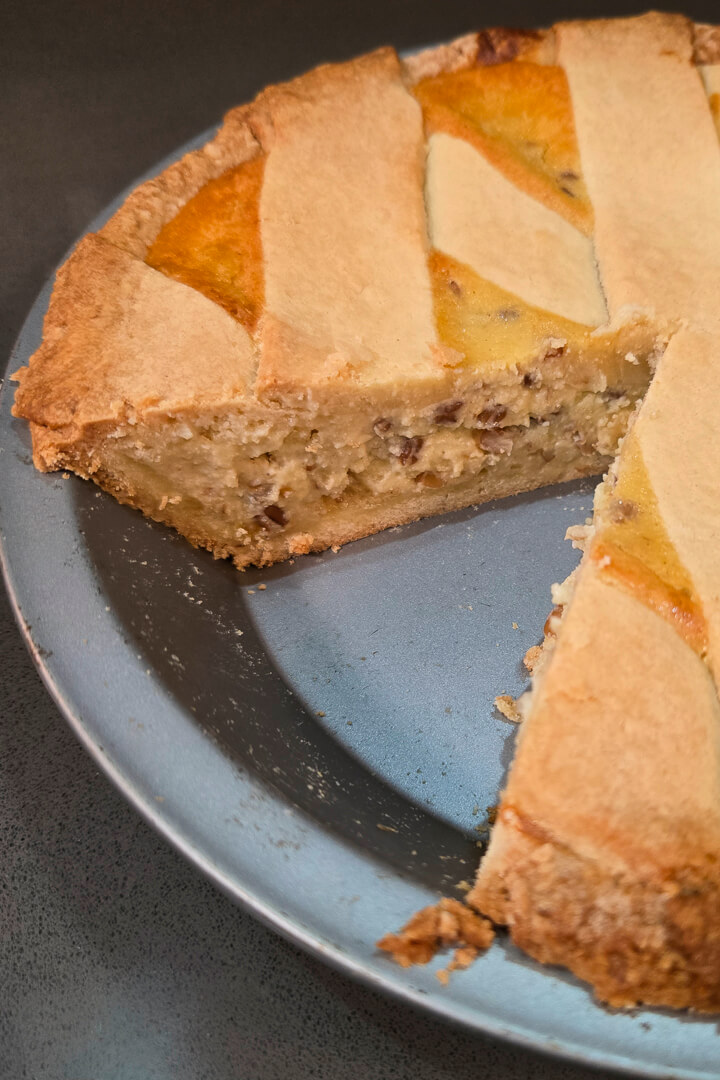
Pastiera Napoletana remains an extremely popular Easter dessert across Italy today. All sorts of stories have cropped up about the traditional recipe and how to follow it. Supposedly, around 2020, a rumor spread on Italian social media that a proper pastiera needs exactly seven strips of lattice to represent the seven ingredients offered to the siren Parthenope. However, people have looked into it and it seems that the rumor doesn’t have any particular historical basis.
Note: Researching pies that have cultural significance in other countries but don’t have a strong presence in English-speaking countries is a bit more challenging than tracing down exact origins and inaccuracies for pies from English-speaking cultures. I used translations from Italian websites for most of my research for this post. Two sites that were most helpful for this history section were this article at “La Cucina Italiana” and this article at the website for the Musea della Cucina.
The Ingredients for a Pastiera Napoletana
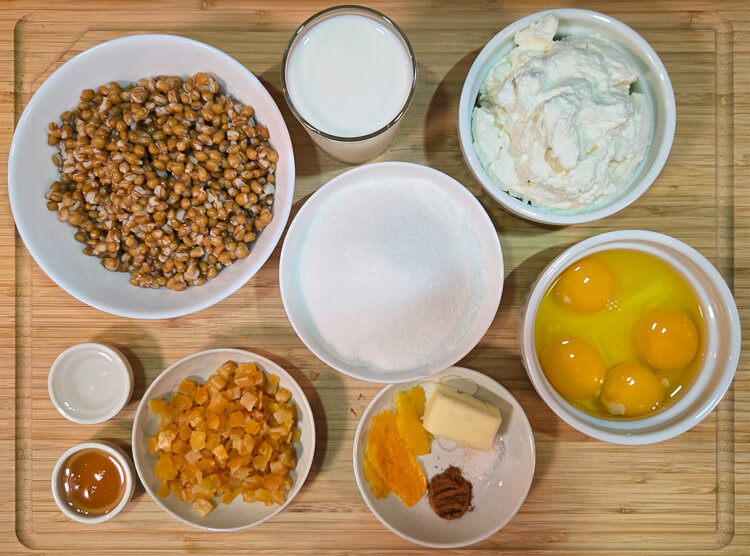
The ingredients in the filling for a Pastiera Napoletana hold a lot of symbolic significance. The origin story of the dessert focuses on seven ingredients that were offered to the siren Parthenope of Greek mythology. The seven ingredients and what they symbolized were:
- Flour – wealth
- Ricotta – abundance
- Eggs – fertility
- Wheat cooked in milk – fusion of the animal and vegetable kingdoms
- Orange blossoms – the scent of Campania
- Spices – a tribute to the people
- Sugar – to celebrate the Siren’s song
Each of these ingredients is important in creating the perfect pastiera.
Flour: Italian 00 Flour
The crust of a Pastiera Napoletana is pasta frolla, or Italian shortcrust pastry. Most Italian pasta frolla recipes call for Italian 00 flour. While in the US, Canada, and some other countries flour is categorized based on its protein content, in Italy flour is categorized based on grind size. 00 flour has the finest grind of all Italian flour varieties.
A finer grind means there’s more total surface area of flour proportional to the weight of the flour. In practical terms, that means 00 flour can usually absorb more water more quickly than all-purpose flour. This translates to higher elasticity in doughs. For pasta frolla specifically, dough made with 00 flour will be slightly easier to roll out than dough made with all-purpose flour.
All-purpose flour is also usually a malted flour, while 00 flour is usually an unmalted flour. Malt contains an enzyme called amylase, which feeds on the starches in the flour and breaks them down into sugars. This is why pasta frolla made with all-purpose flour will brown more quickly in the oven than one made with 00 flour.
I recommend using Italian 00 flour for this Pastiera Napoletana recipe if you can find it. That said, if 00 flour isn’t available where you live or is prohibitively expensive, all-purpose flour is an easy substitute and the difference will be minimal.
Note: I have made my pasta frolla recipe with both Italian 00 flour and American all-purpose flour. Both results were delicious.
Ricotta: Sheep, Buffalo, and Cow’s Milk
Ricotta is a fresh Italian cheese made from the whey of cow, sheep, goat, or water buffalo milk. In other words, it’s made from the byproduct of making other Italian cheeses like mozzarella. The name ricotta comes from the Latin “re-octa,” meaning re-cooked. And if we’re getting really technical, because ricotta is made by reheating whey rather than culturing milk solids, it’s not actually a cheese!
Most Pastiera Napoletana recipes insist on sheep’s milk ricotta, and for good reason. Sheep’s milk has a higher fat content than cow’s milk, which gives the filling a noticeably creamier texture. If you can’t find sheep’s milk ricotta, water buffalo milk ricotta is the next best option. Of all three milks, water buffalo milk has the highest fat content and produces the creamiest results.
That said, sheep’s milk ricotta and water buffalo milk ricotta can both be difficult to track down outside of specialty cheese shops. Cow’s milk ricotta is much easier to find and works beautifully in this Pastiera Napoletana recipe. Just make sure you’re buying full fat ricotta and not reduced fat or fat-free. That part does make a noticeable difference.
Note: I’ve made this filling with both sheep’s milk ricotta and cow’s milk ricotta. Sheep’s milk ricotta is noticeably creamier, but it’s also more expensive and harder to find. The cow’s milk version had a barely noticeable difference in texture and still turned out beautifully.
Grano Cotto: Cooked Wheat Berries
Most Italian recipes for Pastiera Napoletana list “grano cotto” as one of the ingredients. Grano cotto is cooked wheat berries that are, apparently, not too difficult to find sold in jars in Italy. (Or at least, it’s ubiquitous enough there that it doesn’t require explanation.) Unfortunately, unless you live somewhere with Italian specialty stores, or maybe near a very large Italian immigrant population, you’re probably not going to find grano cotto sold in stores.
Grano Cotto: Cooked Wheat Berries
Luckily, it’s not difficult to make your own grano cotto at home. You will need dry wheat berries or spelt berries, both of which can usually be found in the dry goods section of nicer grocery stores. If you can’t find either one, you can use rice to make pastiera di riso, a very similar pie that puts a delicious twist on Pastiera Napoletana.
Do note that while making grano cotto at home isn’t difficult, like many steps in this recipe it does take quite a bit of time. Most notably, you’ll want to soak your wheat berries for a full 24 hours before cooking them.
Ingredients
- 100g Wheat Berries, uncooked (about ½ cup)
- Water
Note: You can use uncooked spelt berries in place of wheat berries as well.
1.
In a bowl, cover the wheat berries with cold water. There should be at least 2 inches (5cm) of water above the wheat berries. Let them soak for a full 24 hours.
2.
After 24 hours, fill a small 1-quart pot with water and place it over medium heat. Bring the water to a boil.
3.
Drain the soaked wheat berries and add them to the boiling water. Make sure the water fully covers the wheat berries.
4.
Lower the heat and simmer for 2 hours, stirring every 30 minutes. Add water as necessary to keep the wheat berries completely submerged.
5.
Drain the wheat berries and set aside.
You can make the grano cotto up to a week in advance and store it in your refrigerator in an airtight container.
Orange Blossom Water and Candied Citrus
You’ll also need orange blossom water and candied citrus for this recipe. Orange blossom water can usually be found in the Mediterranean section of the grocery store, or you can order it on Amazon here. Likewise, candied citrus is often found in the baking aisle near the candied fruit for fruitcake, or you can order it on Amazon here.
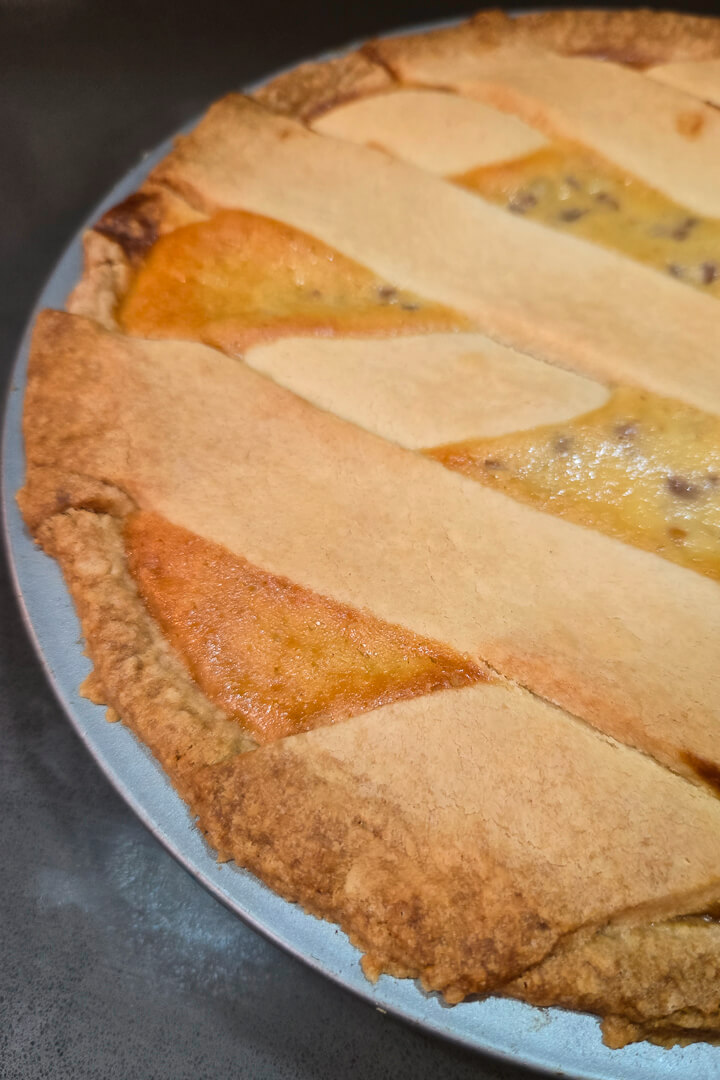
Step-by-Step Pastiera Napoletana Recipe (Italian Easter Pie Recipe)
A quick note on the timing for making this pie. This pie takes a very long time to make! In fact, some traditional recipes say you should start making this pie a full seven days before Easter. Here is a quick breakdown of the timing I recommend so you don’t feel rushed.
Day 1: Make the pasta frolla dough. Wrap it in plastic and store it in your refrigerator. If you need to make your own grano cotto, day 1 is also the day to start soaking your wheat berries.
Day 2: If you’re making homemade grano cotto, boil the wheat berries on day 2.
Day 3: Make the grano cotto in milk. Once it’s done, store it in an airtight container in the refrigerator. Also on day 3, mix together the drained ricotta and sugar and store it in an airtight container in your refrigerator. Many recipes suggest letting the ricotta and sugar sit together for at least two hours or overnight to let the sugar fully dissolve into the ricotta.
Day 4: Make and bake your Pastiera Napoletana!
Days 5-6: Allow your pastiera to rest and let the flavors fully meld together.
Day 7: Serve and enjoy!
Crust:
Pastiera Napoletana, and most other Italian pie and tart recipes, use Italian shortcrust pastry called pasta frolla for the crust. The full recipe and tips for rolling out the pastry can be found here. Note that this recipe has been adapted to fit a standard, North American 9” pie tin.
Pastiera Napoletana Recipe
This recipe may use some ingredients that you’re not familiar with. Please read the section above for notes on the ingredients used in this recipe and substitutions depending on their availability where you live.
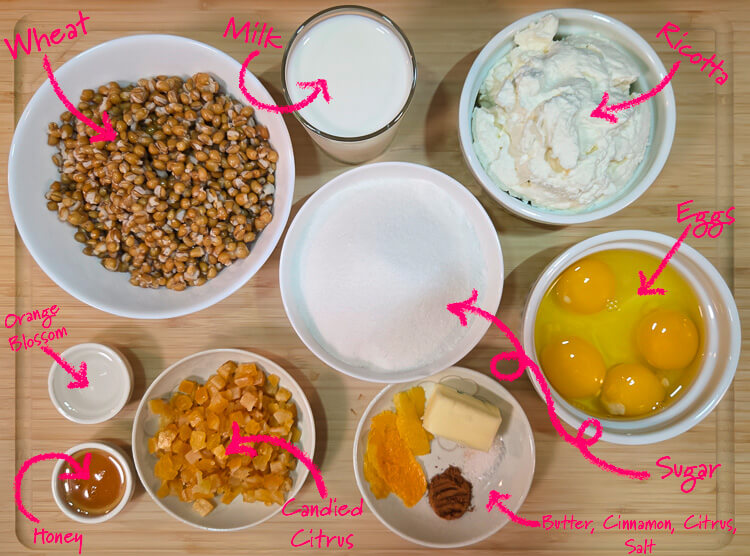
Ingredients
- 1 batch Pasta Frolla
- 1¼ cup Grano Cotto or cooked wheat berries
- ⅔c Whole Milk (160mL)
- 1T Unsalted Butter (14g)
- 1 Orange Peel
- 1 Lemon Peel
- 1¼c Ricotta, full-fat (312g)
- 1¼c Granulated Sugar (250g)
- 3 Eggs
- 1 Egg Yolk
- ¼t Ground Cinnamon
- 2t Orange Blossom Water
- 1½t Honey
- ¼t Salt
- ¼c Candied Citron, or other citrus (~60g)
Note: This pie is a multi-day endeavor. Please see my notes on timing above.
1.
Drain the ricotta, removing any excess moisture.
2.
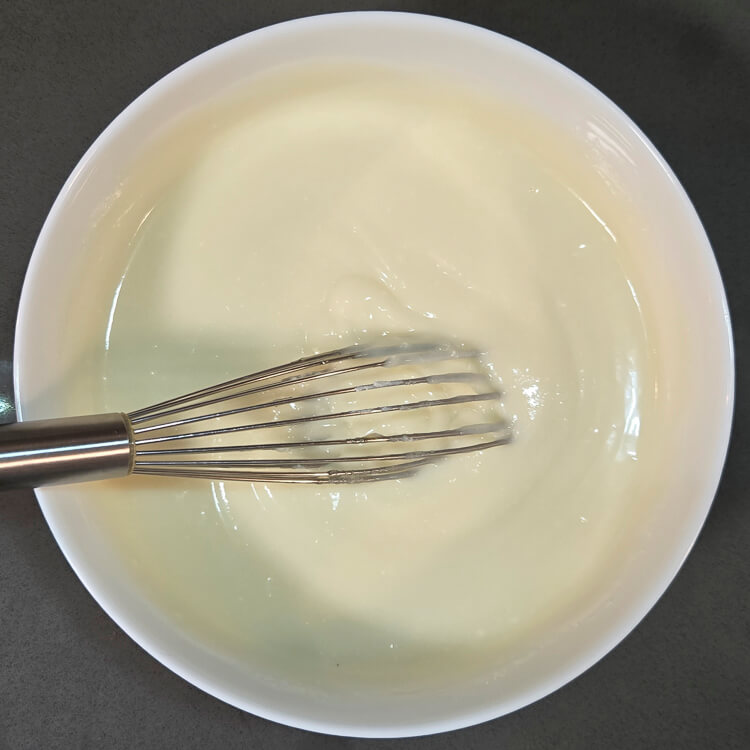
In a small bowl, whisk together the ricotta and granulated sugar until smooth and fully combined. Wrap the bowl in plastic and store in the refrigerator for at least two hours or overnight.
3.
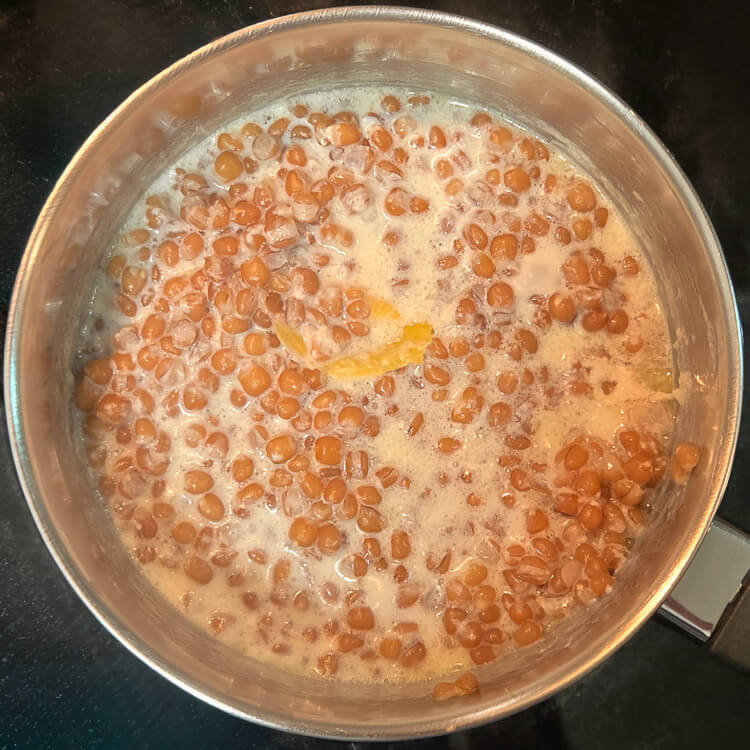
In a small 1-quart pot, combine the cooked wheat berries, milk, butter, orange peel, and lemon peel.
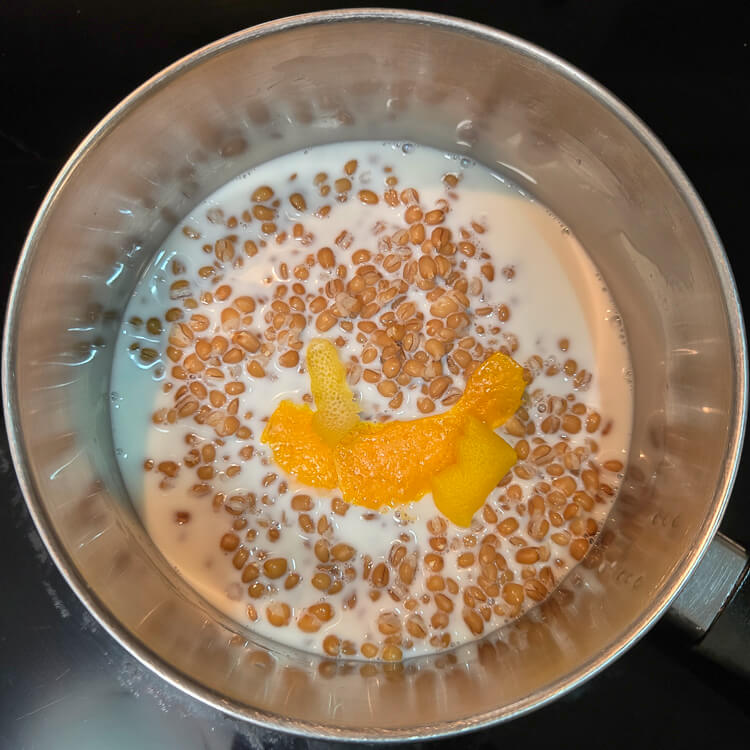
Note: If you don’t have access to grano cotto or cooked wheat berries where you live, please see my instructions earlier in the post for how to make homemade grano cotto.
4.
Simmer over low heat for 30 minutes, stirring occasionally.
5.
Remove the mixture from heat and carefully remove the lemon and orange peels.
6.
Remove ¼ cup of the cooked wheat mixture and blend it until smooth.
Tip: Use a small blender like a Magic Bullet, mash it with a fork, or use a small immersion blender. Breaking up the cooked wheat releases the starches, which will help thicken and bind the final filling.
7.
Stir the blended mixture back into the rest of the cooked wheat mixture and set aside to cool. If you are letting the ricotta mixture from step 2 sit overnight, you can also let this mixture sit overnight.
8.
While the ricotta mixture from step 2 is resting, roll out one half of the prepared pasta frolla and fit it into your pie tin. Prick all over with a fork and transfer the tin to the refrigerator while you prepare the rest of the filling.
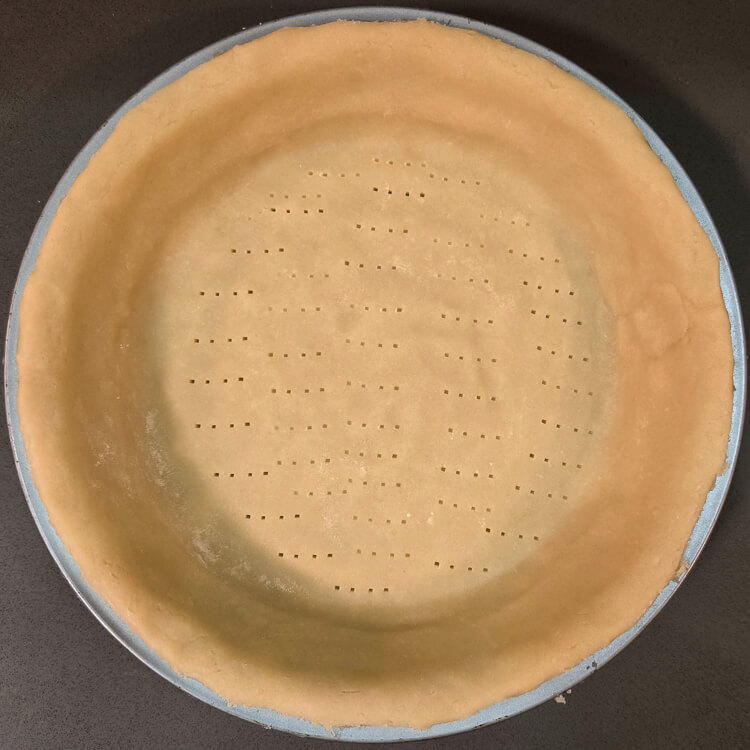
Note: For tips and instructions on how to roll out and fit the pasta frolla into a pie tin, see this post on pasta frolla.
9.
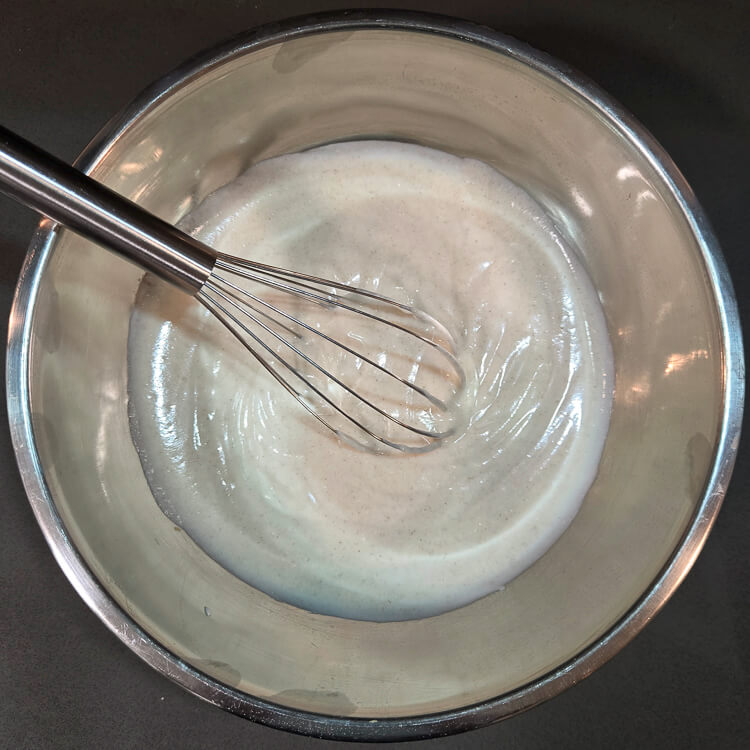
Transfer the ricotta mixture from step 2 into a large mixing bowl. Whisk in the ground cinnamon and orange blossom water.
10.
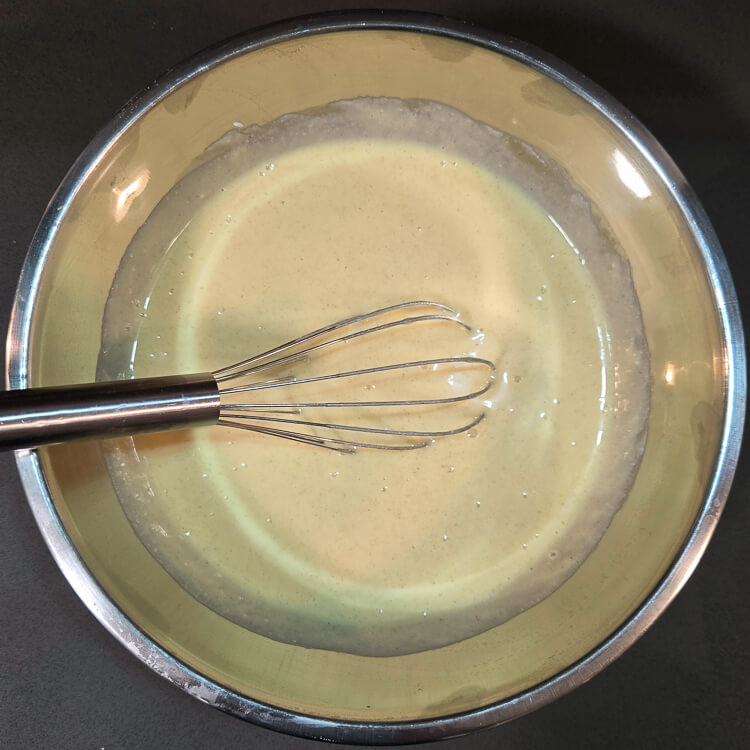
Add the eggs and egg yolk, whisking in one at a time until fully incorporated.
11.
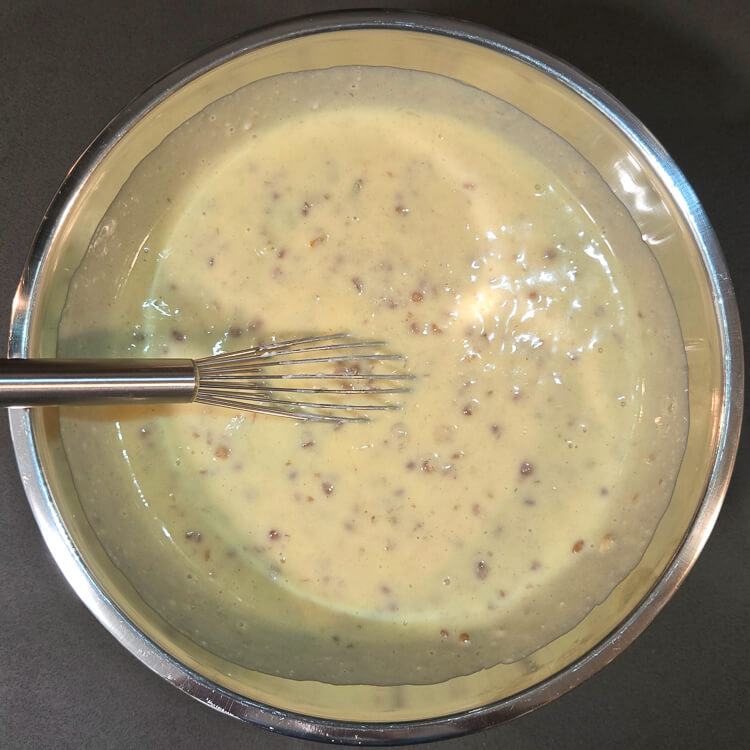
Whisk in the cooked wheat mixture from step 7 and the candied citrus.
12.
Set the filling aside for 1 hour to allow the flavors to meld.
13.
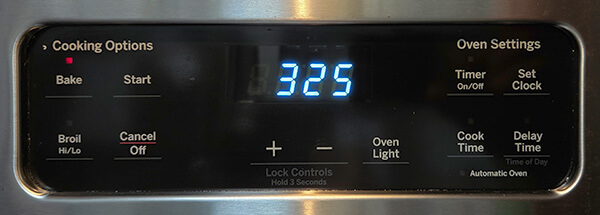
Preheat the oven to 325°F (165°C).
14.
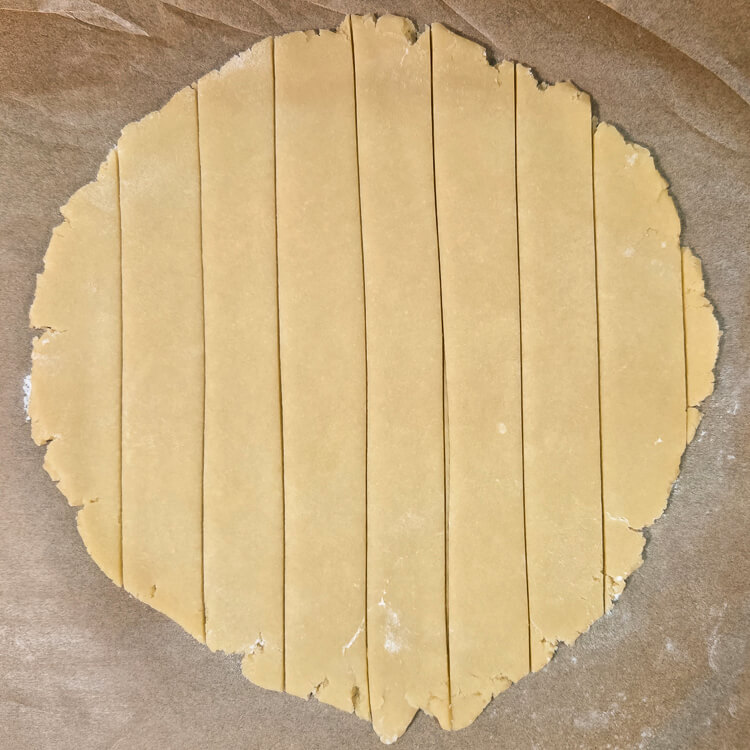
While the filling is resting, roll out the other half of the pasta frolla dough. Using a 5-wheel pastry cutter or a pizza cutter, cut about 7 strips of dough 1½” (4cm) wide. The dough will be easiest to work with if you roll it out on a piece of parchment paper.
15.
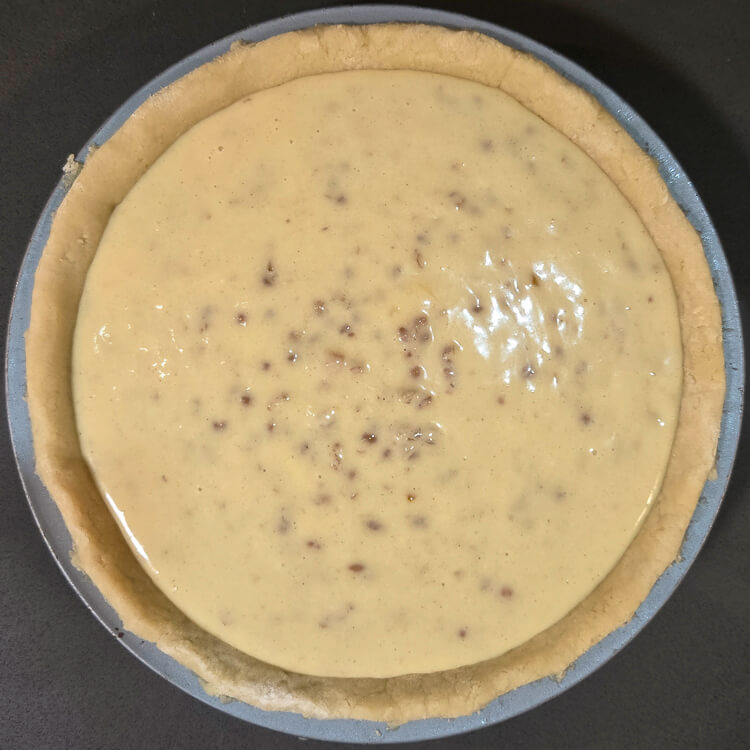
Remove the pie tin fitted with pasta frolla dough and place it on a sheet pan lined with parchment paper. Fill the pie with your prepared filling from step 12, leaving about 1cm (½”) of space from the top of the tin.
16.
Carefully place 4 parallel strips of pasta frolla from step 14, evenly spaced, over the top of the pie. Press the edges of the strips to the dough fitted to the pie tin to seal the crust.
17.
Take another 3 strips of pasta frolla and change the angle so that diamond shapes are created between the strips of dough. Evenly space them and seal them to the bottom crust.
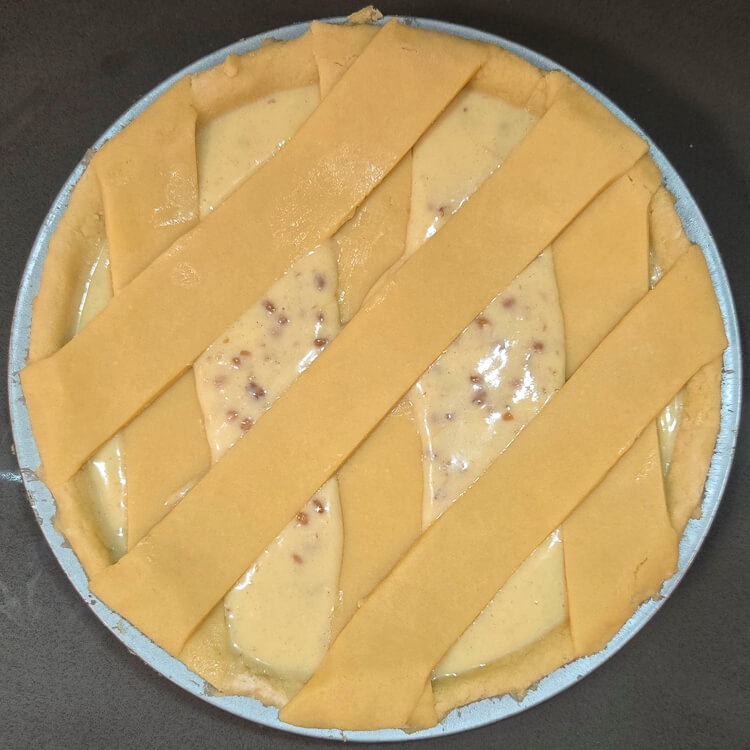
Note: You are not creating a woven lattice. All the strips facing one direction sit on top of all the strips facing the other direction.
18.
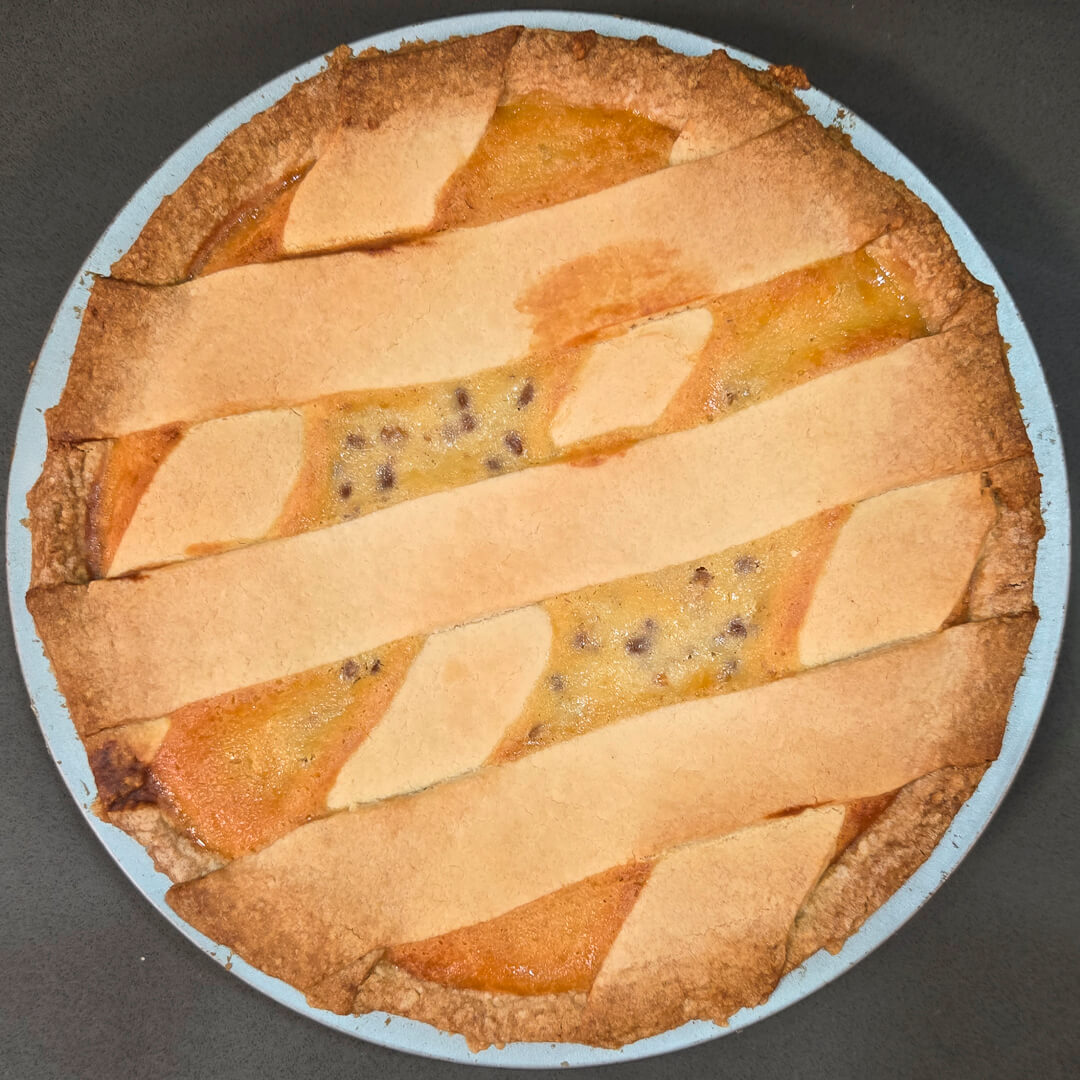
Carefully transfer the pie to your preheated oven and bake for 45-50 minutes until the top crust is just starting to brown.
19.
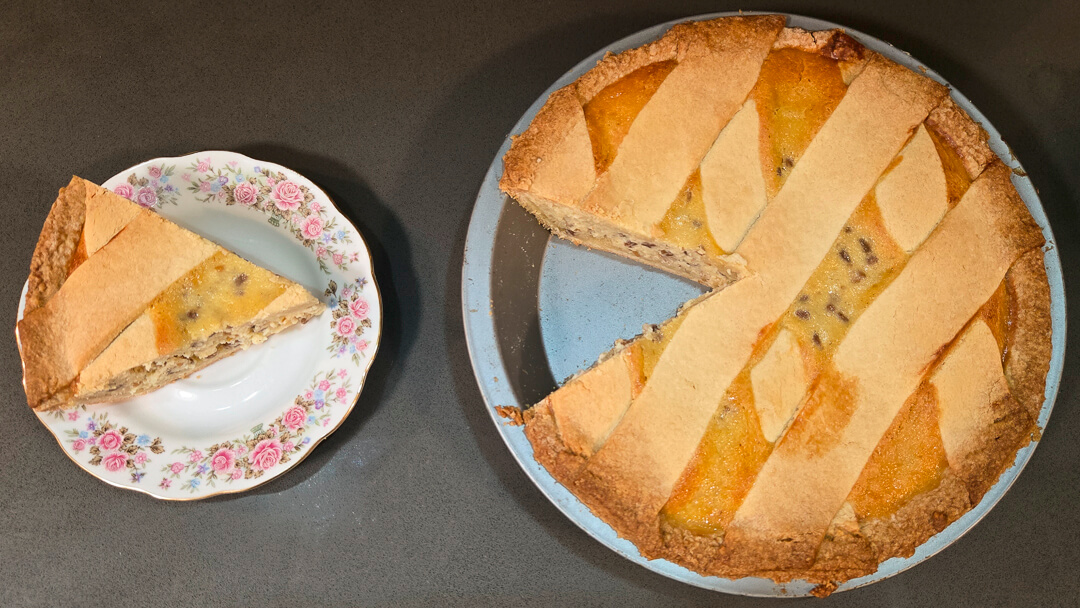
Remove the pie from the oven and allow it to cool at room temperature for about 30 minutes. For the best flavor, transfer the pie to the refrigerator and let it rest for 3 days before serving.
Why Should You Let a Pastiera Napoletana Rest for 3 Days Before Eating?
Many recipes for this Italian Easter Pie call for letting the pie rest for three days after baking before serving it. While a Pastiera Napoletana is still delicious even if you don’t wait to eat it, there are a few real benefits to letting the flavors meld over time. First, the essential oils in the citrus fully incorporate into the ricotta filling, giving the filling a full-bodied citrus flavor. Second, the wheat berries have more time to fully soften. Third, many people think the texture of the crust is actually better after a few days, once it has absorbed some of the flavors of the pie. Finally, some people say that the filling becomes noticeably creamier if you allow it time to rest.
Other Italian Pies
Although it may be the most famous, this Italian Easter pie is just one of many delicious Italian pies and tarts.
- Pastiera di Riso: Similar to Pastiera Napoletana and also traditionally made around Easter, pastiera di riso has a filling made with arborio rice and ricotta flavored with orange blossom water.
- Torta di Mele Cremosa: An Italian apples and cream tart with a pasta frolla crust and apple slices baked on top of a custard filling.
- Crostata alla marmellata: A classic Italian jam tart with a pasta frolla crust.

How to Store a Pastiera Napoletana
Because of the eggs and dairy in this recipe, your Pastiera Napoletana should be stored in the refrigerator. This pie actually lasts for quite a long time. In fact, it’s recommended to wait three days after baking before you even dig in. You can store it in the refrigerator wrapped in plastic or in an airtight container for up to one week. After that, it starts to lose some of its freshness.
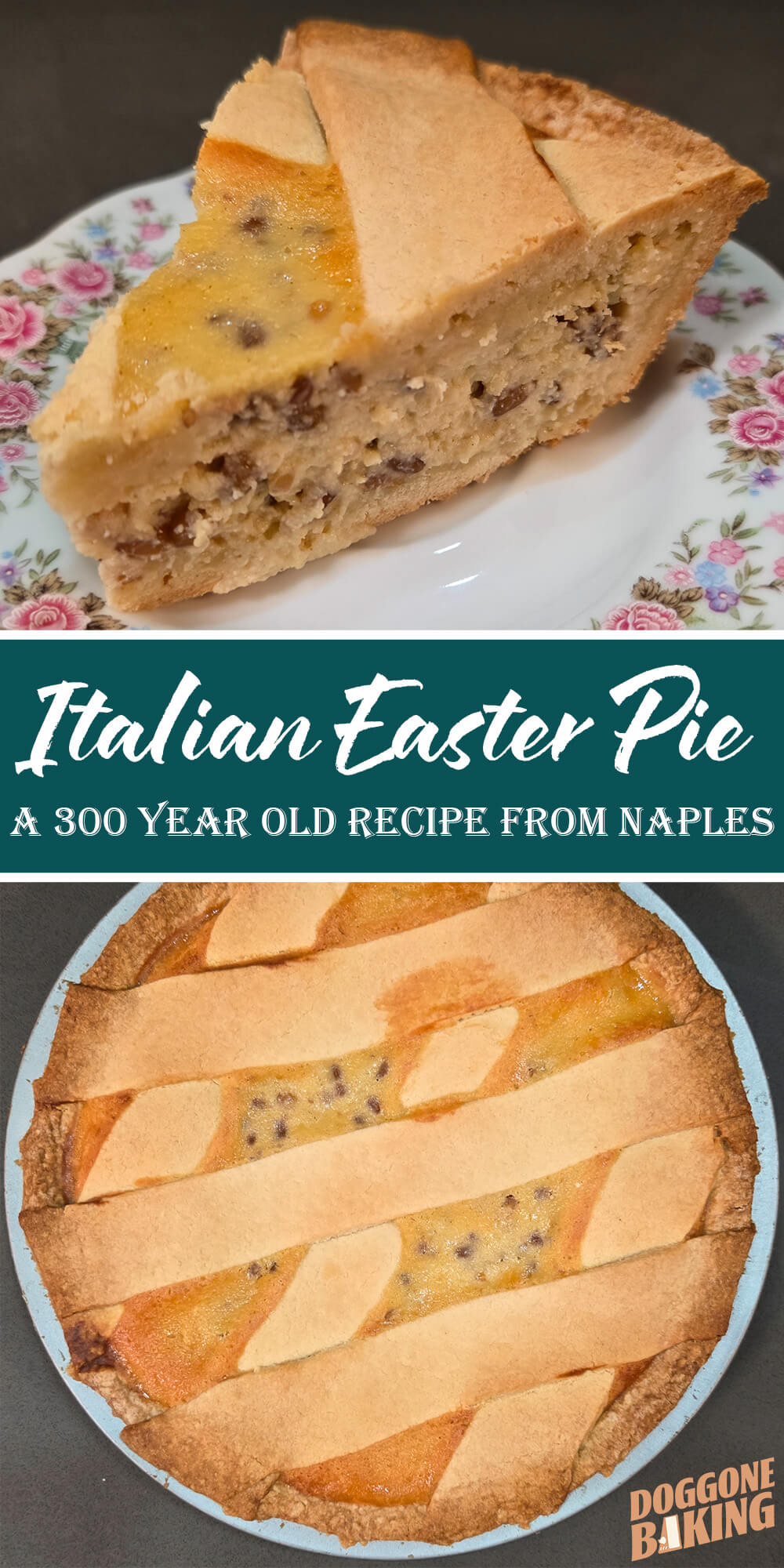
We’d love to see your Pastiera Napoletana creations! If you give this recipe a try, tag @doggone_baking on social media so we can share in the baking fun. Also, please note that I am not Italian! While I’ve done my best to be true to the history, recipe, and methods, please reach out if you feel there are any errors.
Pastiera Napoletana (Italian Easter Pie)
Ingredients
- 1 batch Pasta Frolla (Italian Shortcrust Pastry)
- 1¼ cup Grano Cotto (cooked wheat berries) see notes
- ⅔ cup Whole Milk (160mL)
- 1 tbsp Unsalted Butter (14g)
- 1 strip Orange Peel
- 1 strip Lemon Peel
- 1¼ cups Full-Fat Ricotta (312g) sheep's milk ricotta preferred
- 1¼ cups Granulated Sugar (250g)
- 3 Eggs
- 1 Egg Yolk
- ¼ tsp Ground Cinnamon
- 2 tsp Orange Blossom Water
- 1½ tsp Honey
- ¼ tsp Salt
- ¼ cup Candied Citron (~60g) or other candied citrus
Instructions
- Before beginning this recipe, if you need to make your own homemade cooked wheat berries (grano cotto), please see the instructions in the blog post above, or the notes section of this recipe card.
Make the Ricotta Mixture
- Drain the ricotta, removing any excess moisture.
- In a small bowl, whisk together the ricotta and granulated sugar until smooth and fully combined. Wrap the bowl in plastic and store in the refrigerator for at least two hours or overnight. This allows the sugar to fully dissolve into the ricotta for the creamiest texture.
Make the Grano Cotto Mixture
- In a small 1-quart pot, combine the cooked wheat berries, milk, butter, orange peel, and lemon peel.
- Simmer over low heat for 30 minutes, stirring occasionally.
- Remove the mixture from heat and carefully remove the lemon and orange peels.
- Remove ¼ cup of the cooked wheat mixture and blend it until smooth.
- Stir the blended mixture back into the rest of the cooked wheat mixture and set aside to cool. If you are letting the ricotta mixture from step 2 sit overnight, you can also let this mixture sit overnight.
Make the Pastiera Napoletana
- While the ricotta mixture from step 2 is resting, roll out one half of the prepared pasta frolla and fit it into your pie tin. Prick all over with a fork and transfer the tin to the refrigerator while you prepare the rest of the filling.
- Transfer the ricotta and sugar mixture into a large mixing bowl. Whisk in the ground cinnamon and orange blossom water.
- Add the eggs and egg yolk, whisking in one at a time until fully incorporated.
- Whisk in the cooked wheat mixture you made earlier and the candied citrus.
- Set the filling aside for 1 hour to allow the flavors to meld.
- Preheat the oven to 325°F (165°C).
- While the filling is resting, roll out the other half of the pasta frolla dough. Using a 5-wheel pastry cutter or a pizza cutter, cut about 7 strips of dough 1½" (4cm) wide. The dough will be easiest to work with if you roll it out on a piece of parchment paper.
- Remove the pie tin fitted with pasta frolla dough and place it on a sheet pan lined with parchment paper. Fill the pie with your prepared filling from step 12, leaving about 1cm (½") of space from the top of the tin.
- Carefully place 4 parallel strips of pasta frolla from step 14, evenly spaced, over the top of the pie. Press the edges of the strips to the dough fitted to the pie tin to seal the crust.
- Take another 3 strips of pasta frolla and change the angle so that diamond shapes are created between the strips of dough. Evenly space them and seal them to the bottom crust.
- Carefully transfer the pie to your preheated oven and bake for 45-50 minutes until the top crust is just starting to brown.
- Remove the pie from the oven and allow it to cool at room temperature for about 30 minutes. For the best flavor, transfer the pie to the refrigerator and let it rest for 3 days before serving.
Notes
You’ll need 1/2 cup of uncooked wheat berries and water
- Soak the wheat berries in plenty of water for 24 hours.
- Drain the wheat berries, and simmer them in a fresh pot of water for 2 hours. The water should cover the wheat completely. Add water as needed as it evaporates.
- Drain the water, and store in an airtight container in the refrigerator for up to 1 week until you’re ready to use.

About Me
In 2016, I left my office job and became a professional baker. These days I spend my days testing recipes and baking pies while my two dogs snooze happily nearby.
Leave a Reply